




Description
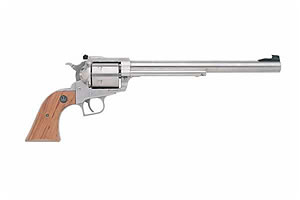
1991 Ruger New Model Super Blackhawk Bisley .44 Mag. 7-1/2
1991 Ruger New Model Super Blackhawk Bisley .44 Mag. 7-1/2
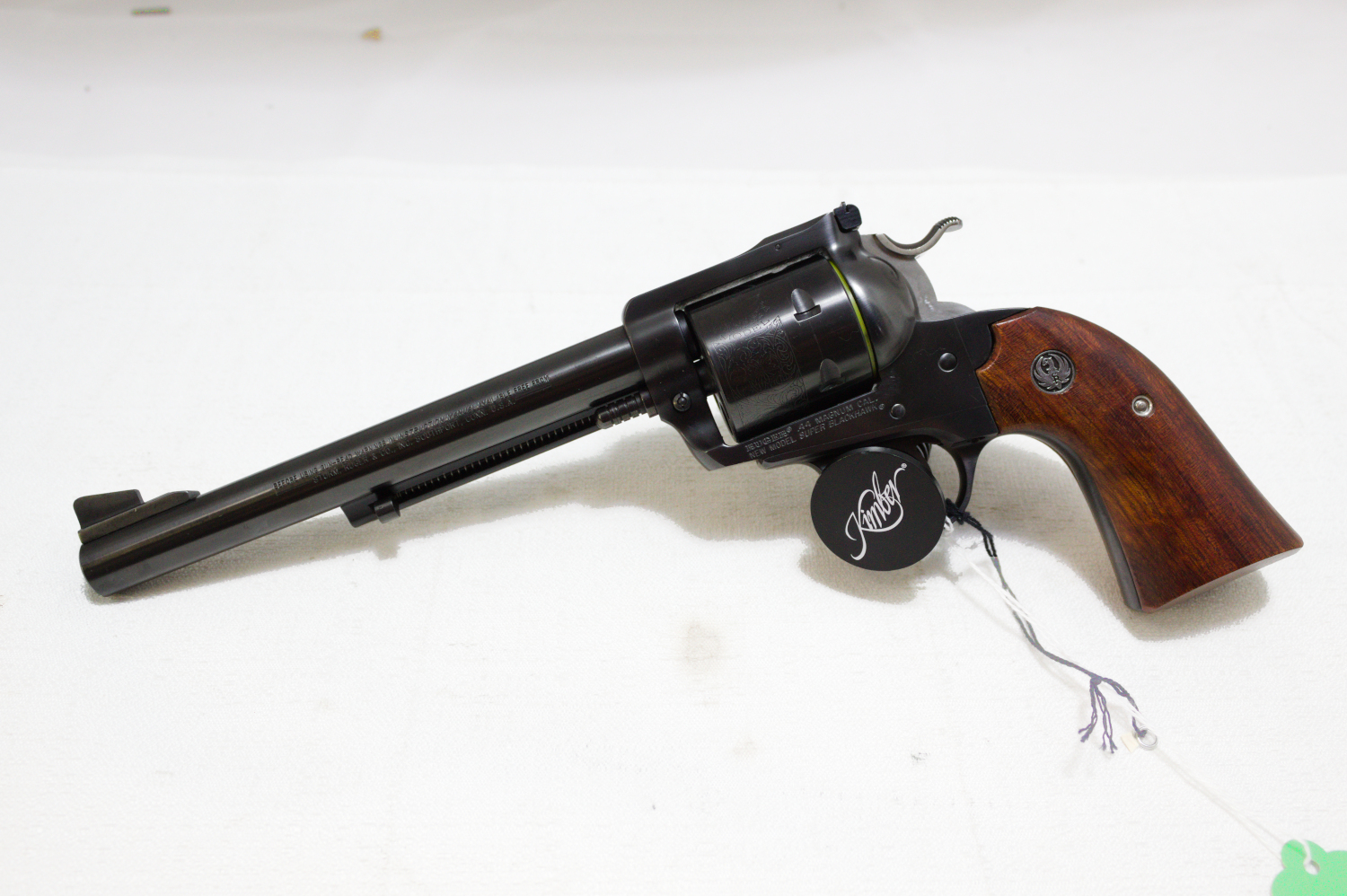
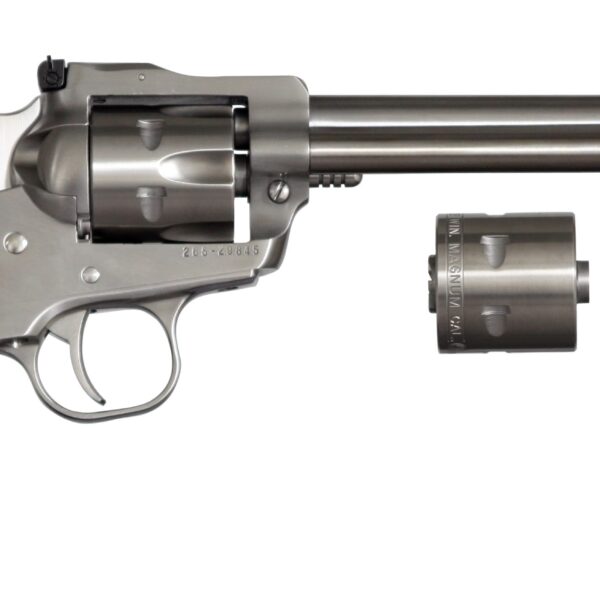
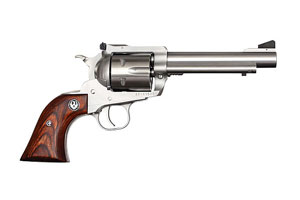
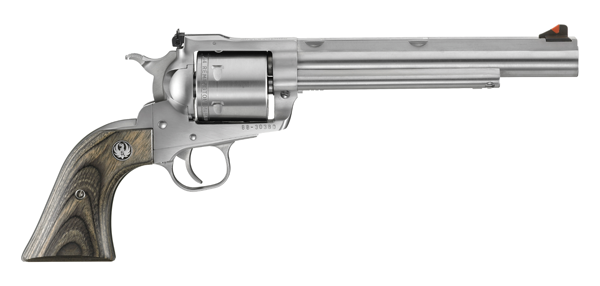
1991 production Ruger Super Blackhawk. Chambered in .44 Magnum with a seven and a half inch barrel. Bisley .44 Mag. 7-1/2″. Bisley configuration with adjustable rear sight and engraved cylinder. Firearm is in like-new condition with no signs of use. Original plastic cylinder cover is still present. Comes in original Ruger box with original manual and paperwork.
This is a particularly interesting Ruger configuration. The New Model Super Blackhawk Bisley combines Ruger’s heavy-duty .44 Magnum Super Blackhawk with the Bisley grip frame, hammer and trigger. Ruger’s serial-history page explicitly groups the Bisley models with the New Model Super Blackhawk family.
Basic identification
-
Manufacturer: Sturm, Ruger & Co.
-
Model: New Model Super Blackhawk Bisley
-
Caliber: .44 Remington Magnum
-
Barrel: 7½ inches
-
Action: Single-action
-
Cylinder: 6 rounds
-
Era: 1991
-
Finish: Typically blued alloy steel for this era, unless your particular example is a special/limited configuration
-
Sights: Ramp front and adjustable rear on the standard Super Blackhawk configuration
-
Cartridge compatibility: .44 Magnum and .44 Special
Ruger’s current description of the New Model Super Blackhawk confirms the .44 Magnum/.44 Special chambering, transfer-bar mechanism, adjustable rear sight and traditional Super Blackhawk grip configuration.
The important 1991 serial-number point
Ruger’s official serial-number table gives:
-
1990: beginning approximately 86-15257
-
1991: beginning approximately 86-35272
So a New Model Super Blackhawk with a serial number in the approximate 86-35272 through 86-42410 range is consistent with a 1991 shipment. Ruger cautions that these are approximate first-shipped numbers, not exact manufacturing dates and that guns can be manufactured or shipped out of serial sequence.
That distinction matters for an unfired, original-box gun: the date you see from the serial number is essentially a production/shipping-era indication rather than proof of the exact day it was manufactured.
What makes the Bisley special?
The Bisley isn’t simply a standard Super Blackhawk with different grips.
The Bisley configuration changes the grip frame, hammer and trigger. Ruger’s manual describes the New Model Bisley as having the New Model Blackhawk mechanism but with these important differences.
The Bisley grip has a distinctive downward angle and a larger, fuller shape. This was intended to give the shooter a different relationship with the substantial recoil of cartridges such as .44 Magnum.
The Bisley hammer also has a different profile and the trigger geometry/shape differs from the conventional Blackhawk.
Why the 7½-inch barrel matters
The 7½-inch version is the classic long-barrel Super Blackhawk configuration.
The long barrel provides:
-
Longer sight radius
-
Greater overall weight
-
A substantial sighting plane
-
Less compact dimensions than the 4⅝- or 5½-inch configurations
The Super Blackhawk’s large frame and grip were specifically associated with handling the .44 Magnum. Modern Ruger Super Blackhawks continue to use the same basic concept. 1991 Ruger New Model Super Blackhawk Bisley .44 Mag. 7-1/2
Super Blackhawk vs. ordinary Blackhawk
The distinction is important.
The Super Blackhawk was designed around the .44 Magnum and has historically used features such as the larger grip configuration and heavier construction. Contemporary descriptions of the 7½-inch Super Blackhawk identify the larger grip and unfluted cylinder as characteristic features.
The Bisley then adds its own grip-frame/hammer/trigger configuration to that platform.
So your revolver is essentially:
New Model mechanism + Super Blackhawk .44 Magnum platform + Bisley grip/hammer/trigger.
New Model safety system ; 1991 Ruger New Model Super Blackhawk Bisley .44 Mag. 7-1/2
Because this is a New Model, it incorporates Ruger’s transfer-bar mechanism rather than the old three-screw/Old Model hammer arrangement.
Ruger describes the New Model Super Blackhawk’s transfer-bar system and loading-gate interlock as safety features.
This is one of the major mechanical distinctions between an early three-screw Super Blackhawk and the later New Model guns.
.44 Magnum / .44 Special
The revolver is chambered for .44 Magnum, and Ruger states that its .44 Magnum Super Blackhawks can also accept factory .44 Special ammunition. 1991 Ruger New Model Super Blackhawk Bisley .44 Mag. 7-1/2
That gives the owner two very different levels of cartridge performance, with .44 Special generally producing substantially less recoil and blast than .44 Magnum.
“Unfired & In-Box” is important for collector value
If the description is accurate, the condition is considerably more significant than simply having an excellent-condition used Bisley. 1991 Ruger New Model Super Blackhawk Bisley .44 Mag. 7-1/2
For a claimed 1991 unfired, original-box example, I’d want to establish:
-
The original serial number
-
Original Ruger box
-
Matching serial number on the box
-
Original instruction manual
-
Original factory paperwork
-
Factory lock/accessories if originally supplied
-
No cylinder turn-line or other evidence of firing
-
Original grips and grip hardware
-
Correct factory sights
-
No evidence of gunsmithing or replacement parts
A revolver can be mechanically unfired yet have handling marks, and conversely a gun described as “unfired” may have been dry-fired or otherwise manipulated. “Unfired” should therefore be distinguished from “mint” or “new old stock” unless the provenance supports it.
Originality is especially important
For a collector example, I would not recommend refinishing, polishing, replacing parts, or otherwise altering it simply to make it look newer. An original 1991 finish with appropriate factory packaging is generally more historically meaningful than a subsequently refinished gun. 1991 Ruger New Model Super Blackhawk Bisley .44 Mag. 7-1/2
A note about the word “1991”
Ruger’s official serial table establishes 1991 as an approximate shipping year for the relevant serial range. It doesn’t establish that every Bisley with that prefix was necessarily assembled during calendar 1991. Ruger explicitly warns that serial blocks can be produced out of sequence and that firearms may remain in storage before shipment.
For an exact factory history, Ruger says its Service Department can provide information, and it offers a Letter of Authenticity process for applicable firearms.
What I’d want to see to identify yours precisely
If you’re evaluating a particular 1991 7½” Bisley, send me:
Super Blackhawk vs. ordinary Blackhawk
Because this is a New Model, it incorporates Ruger’s transfer-bar mechanism rather than the old three-screw/Old Model hammer arrangement. 1991 Ruger New Model Super Blackhawk Bisley .44 Mag. 7-1/2
-
The first 4–5 digits/characters of the serial number (you can hide the rest)
-
A photo of both sides of the revolver
-
Photo of the box end label
-
Photo of the top strap/barrel markings
-
Photo of the cylinder
-
Whether the box has the original manual/paperwork
Reviews
There are no reviews yet.